As electricity prices continue to rise, many homeowners are looking for better ways to understand how energy is being used throughout the home. A household electricity monitor provides real-time visibility into electricity consumption, helping users identify energy waste, reduce utility bills, and improve overall energy efficiency.
Unlike traditional utility meters that only show total energy usage, modern electricity monitoring systems provide detailed information about how and when energy is consumed. Some solutions can even track solar production, appliance loads, and historical energy trends through mobile apps and cloud dashboards.
Whether you want to reduce monthly electricity costs, monitor a solar installation, or simply understand where your energy is going, a household electricity monitor can provide valuable insights.
What Is a Household Electricity Monitor?
A household electricity monitor is a device that measures electricity consumption inside a home and displays energy data in real time.
Depending on the system, users can monitor:
- Real-time power usage
- Voltage and current
- Daily electricity consumption
- Monthly energy trends
- Solar energy production
- Grid import and export
- Historical energy reports
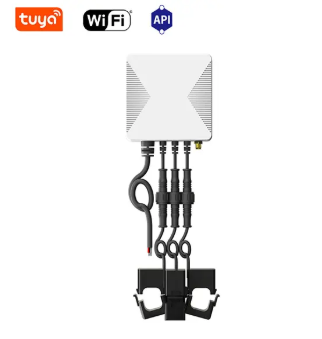
Most modern systems connect to WiFi or smart home platforms, allowing homeowners to access energy information from smartphones or web dashboards.
Why More Homeowners Are Installing Electricity Monitors
Many families receive a monthly electricity bill without knowing which devices are responsible for the highest energy consumption.
A household electricity monitor helps answer questions such as:
- Why is my electricity bill increasing?
- How much power does my HVAC system use?
- Is my EV charger increasing household consumption?
- How much energy does my solar system produce?
- What appliances consume energy while idle?
By understanding energy usage patterns, homeowners can make informed decisions about energy-saving improvements.
Household Electricity Monitor vs Smart Plug
Many homeowners initially use smart plugs to measure energy consumption.
However, smart plugs can only monitor individual devices.
| Feature | Smart Plug | Household Electricity Monitor |
|---|---|---|
| Individual Appliance Monitoring | Yes | Limited |
| Whole-Home Monitoring | No | Yes |
| Solar Monitoring | No | Yes |
| Historical Energy Data | Limited | Yes |
| Grid Import / Export Tracking | No | Yes |
| Multiple Circuit Visibility | No | Yes |
For users who want a complete view of household energy consumption, a whole-home electricity monitor is often the better solution.
What Features Should You Look For?
When selecting a household electricity monitor, several features are especially useful:
Real-Time Monitoring
Provides immediate visibility into electricity usage.
Historical Energy Reports
Allows users to compare energy consumption over time.
Solar Energy Monitoring
Useful for homeowners with rooftop solar systems.
WiFi Connectivity
Enables remote access through mobile applications.
Bidirectional Energy Measurement
Tracks both electricity consumption and solar production.
Easy Installation
Clamp-based energy monitors are often easier to install than traditional inline meters.
Example: Smart Household Energy Monitoring Solutions from OWON
As a smart energy meter manufacturer, OWON develops and manufactures a range of household electricity monitoring solutions designed for modern homes.
For example:
PC311 WiFi Power Clamp
The PC311 supports real-time monitoring of energy usage, voltage, current, power factor, and active power. It also supports historical usage trends and optional dual-CT monitoring for residential energy applications.
PC321 WiFi Whole-Home Energy Monitor
The PC321 supports single-phase, split-phase, and three-phase systems while providing whole-home energy monitoring, bidirectional measurement, and historical energy analytics. It is particularly suitable for households with solar installations and advanced energy management requirements.
PC472 WiFi Energy Meter
The PC472 provides real-time energy monitoring, historical consumption records, and optional relay control through the Tuya platform, allowing homeowners to monitor and manage household electricity usage remotely.
How Household Electricity Monitoring Supports Smart Homes
Household electricity monitors are becoming an important part of modern smart home ecosystems.
They can help homeowners:
- Reduce electricity costs
- Improve solar self-consumption
- Monitor EV charging
- Track HVAC energy usage
- Identify energy waste
- Support home energy management strategies
As more homes adopt solar panels, battery storage systems, and smart appliances, real-time energy visibility is becoming increasingly valuable.
FAQ
Does a household electricity monitor reduce electricity usage?
The monitor itself does not reduce energy consumption, but it helps homeowners identify waste and make informed energy-saving decisions.
Can I monitor my whole house with one electricity monitor?
Yes. Whole-home monitoring solutions using CT clamps can monitor total household energy consumption.
Can a household electricity monitor work with solar panels?
Yes. Many advanced energy monitors support bidirectional measurement, allowing users to track both solar production and electricity consumption.
Is WiFi required?
Most modern systems use WiFi connectivity for remote monitoring and mobile app access, although some solutions also support Zigbee or other communication methods.