Electricity bills tell you how much energy you used, but they rarely explain where that electricity went. Heating and cooling, water heaters, kitchen appliances, EV charging, pool equipment, and standby loads can all contribute to household consumption.
A WiFi energy monitor can make this usage more visible by measuring electrical activity and sending the data to an app or monitoring platform. Depending on the system, users may be able to see real-time power, historical energy consumption, solar generation, or even individual circuit usage.
But what is the best WiFi energy monitor?
There is no single answer for every home. The best choice depends on the electrical system, what you want to monitor, installation method, current range, software features, and whether solar or automation is involved.
This guide explains the main options and the practical factors worth comparing before choosing one.
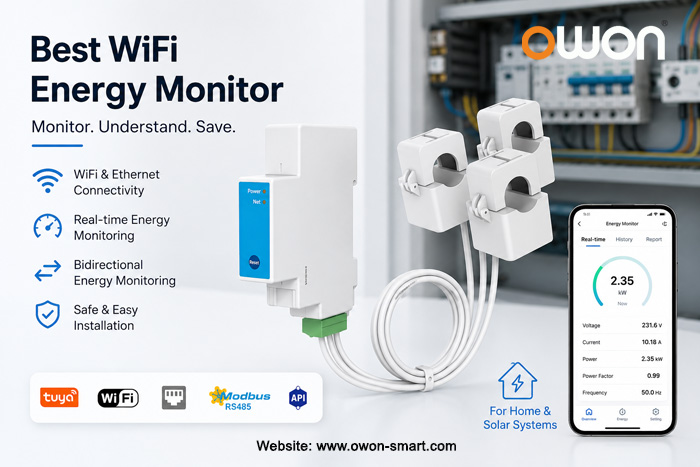
What Is a WiFi Energy Monitor?
A WiFi energy monitor is a device that measures electricity usage and communicates the information over a WiFi network.
Many whole-home monitors use current transformers (CTs) placed around electrical conductors. The CTs measure current without requiring the entire load current to pass through the monitoring device itself.
Depending on the model, a monitor may provide information such as:
- Voltage
- Current
- Active power
- Power factor
- Frequency
- Energy consumption in kWh
- Historical daily, monthly, or yearly usage
More advanced systems may also support bidirectional monitoring, which can distinguish between electricity imported from the grid and energy generated or exported by a solar PV system.
What Is the Best Energy Monitor to Buy?
The best energy monitor is the one that matches both your electrical system and the level of information you actually need.
For example, someone who simply wants to understand total household electricity consumption may only need whole-home monitoring.
Someone trying to determine whether an EV charger, heat pump, water heater, or other major appliance is responsible for high consumption may benefit from circuit-level monitoring.
Before buying, consider five important factors:
1. Electrical System Compatibility
First determine whether the property uses:
- Single-phase power
- Split-phase power
- Three-phase power
This is especially important because electrical systems vary by country and building type.
A typical European home may use single-phase power, while larger homes and commercial properties may have three-phase service. In North America, residential properties commonly use split-phase systems.
For a three-phase installation, a 3 phase wifi power monitor should be designed to measure all relevant phases rather than relying on a monitor intended only for single-phase use.
2. Whole-Home or Circuit-Level Monitoring
Whole-home monitoring provides a useful overview of total electricity consumption.
Circuit-level monitoring goes further by measuring selected circuits separately.
For example, separate monitoring could help compare the consumption of:
- Heat pumps
- Air conditioners
- EV chargers
- Water heaters
- Kitchen equipment
- Solar circuits
Neither approach is inherently better. The right choice depends on how much detail you need.
3. CT Clamp Capacity
CT clamp energy monitors are available with different current ranges and clamp sizes.
The CT should match the conductor size and expected current of the circuit being measured. Choosing an incorrectly sized CT can create installation problems or affect measurement performance.
Before purchasing, check both the rated current and the physical opening of the CT.
4. Real-Time and Historical Data
Real-time power tells you what is happening now.
Historical energy data tells you what has been happening over time.
For example, real-time monitoring may reveal that a large appliance is currently drawing several kilowatts, while historical data can show whether that load operates for one hour or eight hours each day.
For household energy management, both views can be valuable.
5. Solar and Bidirectional Monitoring
Homes with solar PV have different monitoring requirements from homes that only consume grid electricity.
A suitable system may need to distinguish between:
- Grid import
- Solar generation
- Household consumption
- Energy exported to the grid
If solar is part of the installation, check whether the energy monitor supports bidirectional measurement rather than assuming every WiFi monitor can measure energy flow in both directions.
Are Smart Energy Monitors Worth It?
They can be, but their value depends on how the information is used.
Simply watching a real-time power number does not automatically reduce an electricity bill.
The value comes from identifying patterns and acting on them.
For example, monitoring may help reveal that:
- A water heater is operating longer than expected.
- HVAC equipment is responsible for a large share of daily consumption.
- An EV is regularly charging during expensive tariff periods.
- Equipment is still consuming electricity when the property is unoccupied.
- Solar generation and household consumption occur at different times.
These insights can help users change schedules, investigate inefficient equipment, or shift flexible loads to more appropriate times.
Energy monitors should therefore be viewed as measurement and decision-support tools, rather than devices that automatically guarantee energy savings.
What Is the Best Way to Monitor Electricity Usage at Home?
For many households, a layered approach works best.
The utility smart meter provides the official measurement used for billing. A whole-home energy monitor can provide more frequent visibility into consumption, while circuit-level monitoring or plug-in power meters can provide additional detail for selected appliances.
The appropriate combination depends on the question you are trying to answer.
If you want to know:
“How much electricity is my entire house using?”
Whole-home monitoring is usually the logical starting point.
If you want to know:
“How much electricity does this refrigerator or computer use?”
A plug-in power meter may be simpler.
If you want to know:
“How much electricity does my heat pump, EV charger, or water heater use?”
Circuit-level monitoring may provide more useful information.
Can Smart Meters Run on WiFi?
The terminology can be confusing.
A utility smart meter and a consumer WiFi energy monitor are not necessarily the same thing.
Utility smart meters are installed by electricity providers and may use cellular, RF mesh, power-line communication, or other communication technologies. They do not necessarily connect to the homeowner’s WiFi network.
Consumer energy monitors, on the other hand, frequently use WiFi to send measurement data to an app, cloud service, or local platform.
Therefore, when shopping for a WiFi monitoring device, it is important to check the actual communication method rather than assuming that every product described as a “smart meter” uses WiFi.
WiFi Energy Monitor vs Smart Plug
These products solve different monitoring problems.
| Feature | Whole-Home WiFi Energy Monitor | Energy-Monitoring Smart Plug |
|---|---|---|
| Monitoring scope | Whole home or electrical circuits | One plugged-in appliance |
| Typical installation | Electrical panel | Wall outlet |
| CT clamps | Often used | Usually not required |
| Large fixed loads | Suitable with correct specifications | Generally unsuitable |
| Portable appliances | Possible but excessive | Very convenient |
| Solar monitoring | Available on compatible models | Usually not the primary use |
| Professional installation | Often recommended | Usually not required |
For many homes, the two technologies can complement rather than replace each other.
What Makes a Good Smart WiFi Power Monitor?
A good smart wifi power monitor should do more than simply connect to an app.
Look for practical characteristics such as:
- Compatibility with the property’s electrical system
- Appropriate CT current range
- Clear real-time measurement
- Historical energy reporting
- Bidirectional measurement when solar is involved
- Reliable communication
- Appropriate metering accuracy
- Suitable installation method
- Data export or integration options where required
For advanced smart-home projects, automation can also be useful. Energy values can potentially become triggers for other connected devices—for example, responding when grid import or power consumption crosses a defined threshold.
However, automation capabilities vary considerably between products and platforms, so compatibility should be verified before purchase.
CT Clamp or Direct-Wired Energy Monitor?
Another important distinction is how current is measured.
Direct-wired meters route current through the meter or use an appropriate metering connection. CT-based monitors use external current transformers around the conductors.
CT clamps can be particularly useful for existing electrical panels because they allow high-current circuits to be measured without routing the full load through a compact monitoring device.
They are commonly used for:
- Whole-home monitoring
- Three-phase monitoring
- Solar PV monitoring
- Large electrical loads
- Retrofit energy monitoring
Installation inside a distribution panel still involves potentially dangerous voltages, so appropriate electrical safety procedures and local regulations should always be followed. A qualified electrician should be used where required.
How to Choose the Best WiFi Energy Monitor
Rather than looking for one universally “best” model, start with the application.
For a basic home, prioritize simple whole-home monitoring and useful historical reports.
For solar, prioritize bidirectional energy measurement.
For larger electrical systems, confirm single-phase, split-phase, or three-phase compatibility.
For retrofit installations, consider CT-based monitoring.
For smart-home projects, investigate automation and platform compatibility.
For projects where data needs to connect with another software platform, check the available API or communication options before purchasing.
This approach is much more reliable than choosing an energy monitor based only on price, app screenshots, or the number of advertised features.
Final Thoughts
The best WiFi energy monitor is not necessarily the device with the longest feature list. It is the one that answers the energy questions you actually have.
For some households, that means understanding total daily electricity consumption. For others, it means comparing individual circuits, monitoring a solar installation, or identifying loads that remain active unnecessarily.
Start by identifying your electrical system, the circuits you want to measure, and the level of data you need. Then compare CT capacity, measurement functions, historical reporting, solar support, and connectivity.
When these factors are matched correctly, WiFi energy monitoring can turn an electricity bill from a single monthly number into information that is much easier to understand and act upon.