A WiFi power monitor helps you understand how much electricity a home, building, or electrical system is using without relying only on a monthly utility bill. By combining electrical measurement with WiFi connectivity, these devices can provide real-time energy data through an app, web platform, or energy management system.
Modern power monitors range from simple single-phase devices to 3 phase WiFi power monitors for commercial buildings, solar systems, and energy management projects.
So how do they work, and what should you look for when choosing one?
What Is a WiFi Power Monitor?
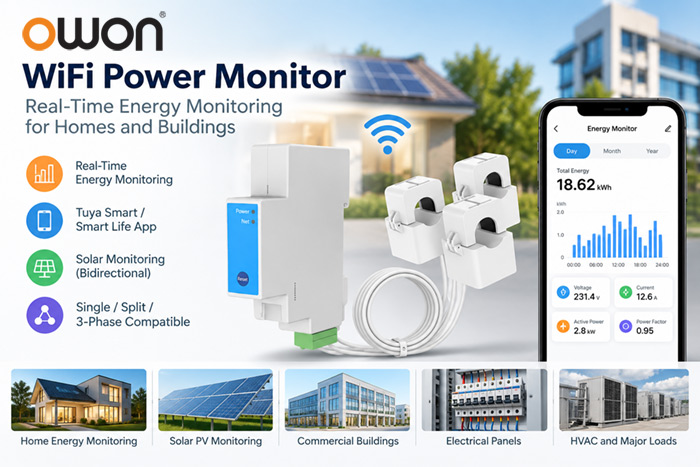
A WiFi power monitor is a connected electrical monitoring device that measures electricity usage and sends the data over a WiFi network.
Depending on the meter, monitored parameters may include:
- Voltage
- Current
- Active power
- Power factor
- Frequency
- Energy consumption
More advanced models can also support bidirectional monitoring for applications such as solar generation and grid import/export.
Unlike a traditional handheld power meter used for temporary testing, a smart power monitor is generally designed for continuous monitoring.
How Do WiFi Power Monitors Work?
Most systems contain three basic parts:
1. Electrical Measurement
The meter measures electrical parameters directly or through external current transformers (CTs). Clamp-type CTs are particularly useful because they can be installed around electrical conductors.
2. WiFi Communication
The meter connects to the local WiFi network and transmits energy data to the relevant monitoring platform.
3. Monitoring Platform
Depending on the product, users may view electricity data through a WiFi power meter app, cloud dashboard, local platform, or third-party energy management system.
This makes it possible to check electricity consumption without being physically next to the electrical panel.
Is There a Way to Monitor Your Electricity Usage?
Yes. A WiFi-connected energy monitor is one option for tracking electricity consumption in real time.
For a home, the meter may be installed at the main electrical panel to monitor overall electricity usage. Additional monitoring channels can be used when more detailed information about individual circuits or loads is required.
For commercial or industrial projects, power monitors can provide energy data for HVAC equipment, electrical panels, solar systems, machinery, or different areas of a building.
The important distinction is that these devices are generally used for energy monitoring and management. They should not automatically be treated as utility billing meters unless specifically certified for that purpose.
Smart WiFi Power Monitor vs Traditional Power Meter
A traditional electrical meter primarily provides electrical measurements. A smart WiFi power monitor adds connectivity and remote data access.
| Feature | Traditional Meter | Smart WiFi Power Monitor |
|---|---|---|
| Electrical measurement | Yes | Yes |
| Real-time monitoring | Varies | Yes |
| WiFi connectivity | Usually no | Yes |
| Remote access | Limited | Yes |
| Historical data | Limited | Often available |
| App/platform integration | Limited | Often available |
| Smart energy applications | Limited | Yes |
For ongoing energy management, connectivity can be particularly useful because energy data becomes available to other software platforms instead of remaining only at the electrical panel.
Single-Phase vs 3 Phase WiFi Power Monitor
The electrical system is one of the first things to check when choosing a power monitor.
A single-phase WiFi power monitor is commonly used for residential electricity monitoring, individual loads, apartments, and smaller electrical systems.
A 3 phase WiFi power monitor is designed for three-phase electrical systems commonly found in commercial buildings, workshops, factories, solar installations, and larger electrical equipment.
A three-phase meter normally uses multiple measurement channels or CT clamps to monitor the relevant phase conductors.
Do not choose a meter simply because it is described as “3 phase.” Always confirm the supported wiring configuration, voltage range, number of CT inputs, and CT current rating.
What About Solar Energy Monitoring?
Solar installations create another important requirement: bidirectional energy monitoring.
A suitable power monitor can distinguish between electricity being consumed and electricity being produced or exported, depending on its measurement capabilities.
This can help users understand:
- Building electricity consumption
- Solar generation
- Grid import/export
- Energy usage trends
For solar projects, confirm that the meter explicitly supports bidirectional measurement rather than assuming that every WiFi meter can measure power flow in both directions.
How to Choose the Best WiFi Power Monitor
There is no single best WiFi power monitor for every application. The right choice depends on the electrical system and monitoring objective.
Before selecting a device, check:
Electrical System – Is it single-phase, split-phase, or three-phase?
Current Range – Select the appropriate CT rating according to the expected electrical load.
Monitoring Scope – Do you need whole-building, individual load, or multi-circuit monitoring?
Bidirectional Measurement – Important for solar and other applications involving two-way energy flow.
Communication and Integration – Consider whether you only need an app or also require MQTT, HTTP, Modbus, Home Assistant, EMS, or BMS integration.
Installation Method – CT clamp and DIN rail designs can provide different installation options depending on the electrical panel.
For professional projects, these technical requirements are usually more important than simply choosing the meter with the most app features.
WiFi Power Monitoring for Professional Energy Projects
For system integrators and energy solution providers, WiFi power monitoring can extend beyond a standalone mobile app.
For example, OWON develops CT-based energy meters for different monitoring architectures. The PC311 is designed for compact single-phase monitoring, while the PC321 can cover single-phase, split-phase, and three-phase applications.
For projects requiring more detailed monitoring, the PC341 provides whole-system and multi-circuit measurement, while the PC4713 is designed for more advanced energy monitoring and system integration.
This range illustrates why selecting a power monitor should start with the electrical architecture and integration requirements, rather than WiFi connectivity alone.
FAQ
Is there such a thing as a WiFi monitor?
Yes. In energy monitoring, a WiFi power monitor measures electrical data and communicates that information through a WiFi network for remote monitoring.
What is a power monitor?
A power monitor is a device used to measure electrical parameters such as voltage, current, power, and energy consumption. Connected models can also provide remote and historical monitoring.
How do WiFi power monitors work?
They measure electrical parameters directly or through sensors such as CT clamps and transmit the data over WiFi to an app, cloud platform, or energy management system.
Can I monitor my electricity usage with WiFi?
Yes. A WiFi energy monitor can provide real-time and historical electricity information, depending on the device and monitoring platform.
Can a WiFi power monitor measure 3-phase electricity?
Yes, if the meter is specifically designed for three-phase systems. Check the supported wiring configuration, CT inputs, voltage, and current range before installation.
Conclusion
A WiFi power monitor provides a practical way to turn electrical measurements into accessible energy data. It can help monitor homes, commercial buildings, solar installations, and other electrical systems in real time.
When choosing between a single-phase or 3 phase WiFi power monitor, focus on the electrical system, CT configuration, monitoring scope, bidirectional measurement, and software integration requirements.
The best solution is not necessarily the meter with the most features—it is the one that matches the electrical system and the way the energy data will actually be used.