As energy costs continue to rise and more buildings adopt renewable energy technologies, monitoring electricity consumption has become increasingly important. Whether you are managing a home, a commercial facility, or a solar installation, access to accurate and reliable energy data helps improve efficiency and reduce unnecessary power usage.
An Ethernet energy meter is designed to provide not only precise electrical measurements but also stable communication through a wired network. Compared with traditional standalone meters, Ethernet-enabled models can transmit real-time energy data directly to monitoring software, building management systems, or cloud platforms.
This guide explains how Ethernet energy meters work, their advantages, common applications, and the key factors to consider before selecting one.
What Is an Ethernet Energy Meter?
An Ethernet energy meter is a digital electricity meter equipped with an Ethernet communication interface. In addition to measuring electrical parameters such as voltage, current, power, and energy consumption, it can send data through a local area network (LAN) for remote monitoring and analysis.
Unlike conventional energy meters that require manual reading, Ethernet-enabled meters continuously transmit data, allowing users to monitor electricity usage in real time from computers, mobile applications, or energy management systems.
Many modern Ethernet energy meters also support communication protocols such as Modbus TCP, making them compatible with industrial automation and building management platforms.
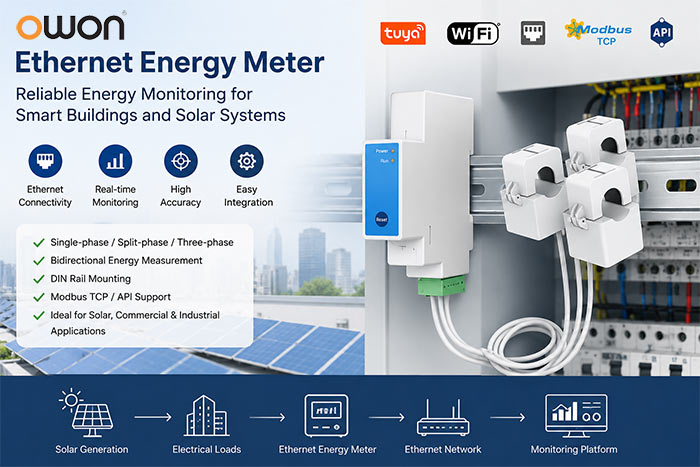
How Does an Ethernet Energy Meter Work?
An Ethernet energy meter measures electrical values from the connected circuit using internal sensing technology. The measured data is processed by the meter’s microcontroller and transmitted through the Ethernet interface using standard network communication.
Once connected to a router or network switch, the meter can communicate with:
- Energy Management Systems (EMS)
- Building Management Systems (BMS)
- Home Energy Management Systems (HEMS)
- Industrial monitoring software
- Cloud-based energy platforms
This enables users to access real-time electrical information without physically visiting the electrical panel.
Benefits of an Ethernet Energy Meter
Stable Communication
Because Ethernet uses a wired network connection, it is generally less affected by wireless interference. This makes it suitable for installations where reliable data transmission is important.
Real-Time Energy Monitoring
Users can continuously monitor electricity consumption, voltage, current, active power, and accumulated energy without waiting for manual meter readings.
Easy System Integration
Many Ethernet energy meters support widely used industrial communication protocols, allowing integration with energy management software and automation systems.
Remote Access
Network connectivity enables facility managers and homeowners to view electrical data remotely, helping identify abnormal consumption and improve operational efficiency.
Scalable Deployment
Multiple Ethernet energy meters can be connected within the same network, making them suitable for projects requiring centralized monitoring of multiple electrical circuits.
Ethernet Energy Meter vs WiFi Energy Meter
Both Ethernet and WiFi energy meters provide remote monitoring capabilities, but they are designed for different environments.
| Feature | Ethernet Energy Meter | WiFi Energy Meter |
|---|---|---|
| Communication | Wired Ethernet | Wireless WiFi |
| Installation | Requires network cable | No network cable required |
| Connection Stability | High | Depends on wireless signal quality |
| Typical Applications | Commercial buildings, industrial facilities, solar systems | Homes, apartments, small offices |
| Network Interference | Low | May be affected by surrounding wireless devices |
Neither solution is universally better. The most suitable option depends on the installation environment, communication requirements, and project size.
Common Applications
Ethernet energy meters are widely used in many industries because reliable communication is increasingly important for energy monitoring.
Typical applications include:
Solar Energy Systems
Monitor electricity generated by photovoltaic systems, household consumption, and power exported to the grid.
Commercial Buildings
Track electricity usage across offices, shopping centers, schools, and public facilities to improve energy efficiency.
Manufacturing Facilities
Collect real-time energy data from production equipment to support energy optimization and preventive maintenance.
Smart Buildings
Provide continuous electrical data for intelligent building management and automation systems.
Residential Energy Monitoring
Some homeowners also choose Ethernet-based monitoring where a stable wired network is preferred over wireless communication.
How to Choose an Ethernet Energy Meter
Before purchasing an Ethernet energy meter, consider the following factors.
Electrical System Compatibility
Choose a meter suitable for your electrical system, whether it is:
- Single-phase
- Split-phase
- Three-phase
- Three-phase three-wire
Communication Protocol
Verify whether the meter supports the communication protocol required by your monitoring platform, such as Modbus TCP or other standard Ethernet communication methods.
Measurement Functions
Look for features that match your application, including:
- Voltage measurement
- Current measurement
- Active power
- Power factor
- Frequency
- Energy consumption (kWh)
- Bidirectional energy measurement for solar applications
Installation Method
DIN rail mounting is commonly used because it simplifies installation inside electrical distribution panels.
Software Compatibility
If the meter will be connected to an existing energy management platform, confirm compatibility before deployment.
An Example of an Ethernet Energy Meter
Modern energy monitoring solutions continue to evolve as buildings become more connected.
For example, the PC4713 Ethernet Energy Meter combines Ethernet communication with real-time electricity monitoring for single-phase, split-phase, and three-phase electrical systems. It also supports bidirectional energy measurement, making it suitable for monitoring both electricity consumption and solar energy generation.
Products like this demonstrate how Ethernet communication can simplify data collection while supporting modern energy management applications without changing the overall purpose of an energy meter.
Conclusion
Energy monitoring is no longer limited to measuring electricity consumption. Today’s systems require continuous data collection, remote access, and reliable communication to support better decision-making.
An Ethernet energy meter offers a practical solution by combining accurate electrical measurement with stable network connectivity. Whether used in solar energy systems, commercial buildings, industrial facilities, or residential projects, it helps users gain better visibility into energy usage and supports more efficient energy management.
As connected energy systems continue to develop, Ethernet-enabled monitoring solutions are expected to remain an important option for applications where reliable communication is a priority.
FAQ
What is an Ethernet energy meter?
An Ethernet energy meter is a digital electricity meter that measures electrical parameters and transmits data through an Ethernet network for remote monitoring and analysis.
What is the advantage of an Ethernet energy meter over a traditional meter?
Unlike traditional meters that require manual reading, an Ethernet energy meter provides real-time data, remote access, and easier integration with energy management systems.
Can an Ethernet energy meter be used for solar systems?
Yes. Many Ethernet energy meters support bidirectional energy measurement, allowing users to monitor both electricity consumption and solar power generation.
Is an Ethernet energy meter suitable for home use?
Yes. While Ethernet energy meters are commonly used in commercial and industrial projects, they can also be installed in homes where a stable wired network is available.
What should I consider before choosing an Ethernet energy meter?
Key considerations include electrical system compatibility, communication protocol, measurement functions, installation method, and software compatibility.