The Hidden Problem with Energy Monitoring Alone
For many years, energy monitoring was considered the final step in energy management. Homeowners, facility managers, and energy professionals installed meters to understand electricity usage, identify inefficiencies, and reduce operating costs.
Today, energy monitoring remains important, but it is no longer enough on its own.
As solar power systems, battery storage, electric vehicles, heat pumps, and smart home technologies become more common, users are expecting more than reports and charts. They want systems that not only display energy data but also help optimize how energy is consumed, stored, and managed.
This shift is changing the role of energy monitoring from a passive reporting tool into an active part of intelligent energy management.
The First Generation of Energy Monitoring
The primary purpose of traditional energy monitoring was visibility.
Users wanted answers to questions such as:
- How much electricity was used today?
- Which month had the highest consumption?
- What is the peak demand level?
- How much energy does a building consume over time?
These insights remain valuable because they help identify waste and establish a baseline for improvement.
However, traditional energy monitoring systems are largely passive. They provide information about what happened but offer little assistance in determining what actions should be taken next.
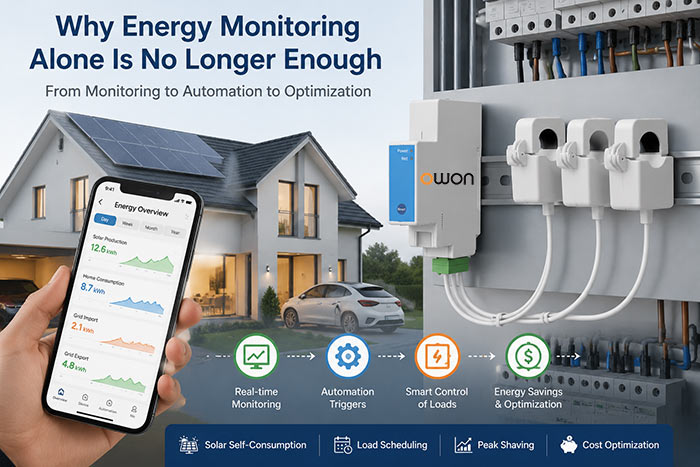
Why Energy Monitoring Alone Is No Longer Sufficient
Modern electrical systems are far more complex than they were ten years ago.
Many homes now include:
- Solar PV systems
- Battery storage
- EV chargers
- Heat pumps
- Smart appliances
Commercial facilities may also include:
- HVAC automation
- Energy storage systems
- Smart lighting controls
- Renewable energy generation
In these environments, simply collecting data is no longer enough.
The real value comes from transforming energy data into decisions and automated actions.
This is why many projects are evolving from basic monitoring toward a more advanced smart energy metering system that can support optimization and automation.
The Rise of Energy-Based Automation
One of the most important trends in modern energy management is the use of energy values as automation triggers.
Traditional automation relied on:
- Time schedules
- Motion sensors
- Door sensors
- Temperature sensors
Today, energy monitoring data itself can drive automation.
Examples include:
- Starting battery charging when excess solar energy is available
- Turning on a water heater when solar production exceeds household demand
- Reducing non-essential loads when power consumption exceeds a predefined threshold
- Delaying EV charging until electricity rates are lower
In these cases, energy monitoring becomes part of an active control strategy rather than a simple reporting function.
Why Solar Energy Has Changed the Conversation
Solar installations have accelerated the need for smarter energy management.
Solar owners no longer focus only on total consumption.
They also want to understand:
- How much energy is imported from the grid
- How much energy is exported
- How much solar generation is self-consumed
- When batteries should charge or discharge
This is where solutions such as a tuya energy meter become increasingly useful because they can provide real-time data while supporting automation workflows inside a connected smart home ecosystem.
Instead of only viewing charts and reports, users can build automated responses based on actual energy conditions.
How Energy Monitoring Is Evolving Into Optimization
The next stage of energy management is optimization.
Rather than asking:
“How much electricity did I use yesterday?”
Users are increasingly asking:
“How can my system automatically reduce energy costs?”
Optimization strategies may include:
- Load shifting
- Solar self-consumption improvements
- Battery scheduling
- Peak demand reduction
- Equipment automation
Energy monitoring remains the foundation, but optimization is where the largest financial benefits are often achieved.
A Practical Example
Consider a homeowner with:
- Solar panels
- Battery storage
- An EV charger
A traditional monitoring system may show:
- Solar production
- Household consumption
- Grid import
Useful information, but limited action.
A more advanced solution can automatically:
- Charge batteries when solar generation exceeds demand
- Start EV charging during periods of excess production
- Reduce non-critical loads when household demand spikes
The difference is significant.
One system provides information.
The other helps generate measurable savings.
The Future of Energy Monitoring and Automation
Energy monitoring will continue to be a critical part of modern energy systems.
However, future projects will increasingly combine:
- Energy monitoring
- Automation
- Optimization
- Energy intelligence
As homes and buildings become more connected, users will expect systems to do more than display numbers.
They will expect systems to help make better decisions automatically.
This is especially important in solar, energy storage, EV charging, and smart building applications where energy conditions change continuously throughout the day.
Solutions that combine monitoring, automation, and bidirectional measurement will become increasingly valuable as energy management evolves.
Conclusion
Energy monitoring remains the foundation of modern energy management, and effective energy monitoring will continue to play a critical role in future smart energy systems.
However, monitoring alone is no longer the destination.
The next generation of energy systems uses data to trigger actions, optimize electricity usage, and improve efficiency automatically.
For homeowners, solar users, and commercial facilities alike, the future is not simply about seeing energy data—it is about making energy data work.