Introduction
Modern energy management is no longer limited to simply measuring electricity consumption. As commercial buildings, solar systems, and industrial facilities become more connected, energy meters need to communicate with monitoring platforms, automation systems, and energy management software.
A Modbus energy meter provides a practical solution by combining electrical measurement with reliable data communication. Through protocols such as Modbus RTU over RS485 or Modbus TCP over Ethernet, these meters allow energy data to be collected, analyzed, and integrated into larger energy monitoring systems.
For applications such as smart buildings, renewable energy projects, and industrial automation, understanding how Modbus communication works can help system designers select the right energy monitoring solution.
What Is a Modbus Energy Meter?
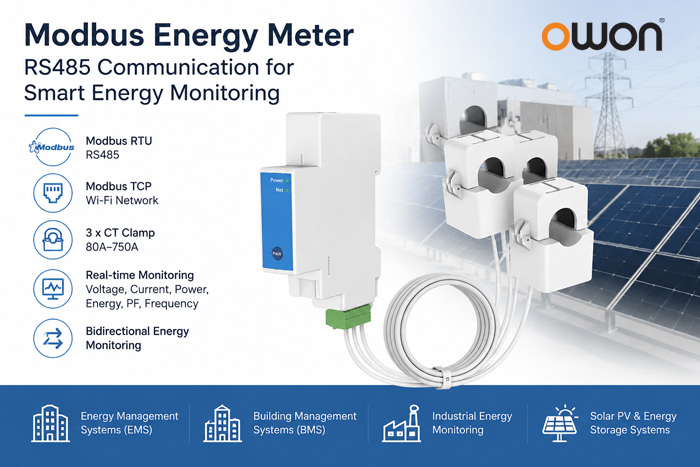
A Modbus energy meter is an electrical measurement device that uses the Modbus communication protocol to transmit energy data to external systems.
Unlike traditional energy meters that only display local measurements, Modbus-enabled meters can share information with:
- Energy Management Systems (EMS)
- Building Management Systems (BMS)
- SCADA platforms
- PLC control systems
- IoT monitoring platforms
Typical measurement data includes:
- Voltage
- Current
- Active power
- Reactive power
- Apparent power
- Power factor
- Frequency
- Energy consumption
This communication capability makes Modbus energy meters widely used in projects that require centralized monitoring and energy optimization.
How Does Modbus Communication Work in Energy Monitoring?
A smart energy meter usually requires both a physical communication interface and a communication protocol.
RS485: The Communication Interface
RS485 is a widely used industrial communication interface known for:
- Long-distance transmission
- Stable communication
- Multi-device networking capability
In many industrial environments, RS485 provides the hardware connection between energy meters and control systems.
Modbus RTU: The Communication Protocol
Modbus RTU is one of the most common protocols used with RS485 energy meters.
It defines how devices exchange information, including:
- Data format
- Addressing method
- Communication commands
Because of its simplicity and reliability, Modbus RTU is widely adopted in:
- Industrial automation
- Energy monitoring
- Building control systems
Therefore, many products are described as RS485 Modbus energy meters, meaning they use RS485 communication with the Modbus RTU protocol.
Modbus TCP: Ethernet-Based Energy Communication
Modbus TCP uses Ethernet networks to transmit Modbus data.
Compared with traditional RS485 communication, Modbus TCP provides easier integration with:
- Network-based monitoring systems
- Industrial Ethernet environments
- Cloud-connected energy platforms
For large commercial projects, combining Ethernet communication with Modbus protocols can simplify system integration.
Why Are Modbus Energy Meters Used in EMS and BMS Projects?
Energy management projects require accurate data collection from multiple locations.
A Modbus energy meter helps provide the data needed for:
Centralized Energy Monitoring
Instead of checking meters individually, system operators can collect energy data from multiple devices through a central platform.
This enables:
- Real-time monitoring
- Historical analysis
- Energy consumption comparison
Building Energy Management
In commercial buildings, energy meters can be integrated with BMS platforms to monitor:
- Lighting systems
- HVAC equipment
- Distribution panels
- Tenant sub-metering
This helps building operators understand energy usage and improve operational efficiency.
Industrial Energy Management
Industrial facilities often require detailed energy monitoring for:
- Production equipment
- Electrical panels
- Manufacturing processes
Modbus communication allows energy data to be integrated with existing automation infrastructure.
Modbus Energy Meter Applications
Solar Energy Systems
Solar projects require accurate monitoring of energy generation and consumption.
A Modbus energy meter can provide data for:
- Solar generation monitoring
- Grid import/export measurement
- Energy management systems
For example, in solar installations with hybrid inverters, energy meters can help monitor power flow between solar generation, battery storage, loads, and the grid.
Commercial Buildings
Commercial facilities often use multiple meters for:
- Electrical distribution monitoring
- Tenant sub-metering
- Energy cost analysis
Modbus communication allows these meters to connect with centralized management platforms.
Industrial Automation
In industrial environments, Modbus energy meters can work together with:
- PLC systems
- SCADA software
- Industrial control platforms
This enables more detailed energy visibility across production areas.
Modbus RTU vs Modbus TCP Energy Meters
Both Modbus RTU and Modbus TCP are widely used for energy monitoring, but they serve different project requirements.
| Feature | Modbus RTU | Modbus TCP |
|---|---|---|
| Communication Interface | RS485 | Ethernet |
| Typical Applications | Industrial automation, PLC systems | Network-based EMS and BMS |
| Communication Method | Serial communication | Ethernet communication |
| Common Deployment | Local device networks | Larger connected systems |
The choice depends on the existing infrastructure and integration requirements.
For projects using traditional industrial control systems, RS485 Modbus RTU meters are commonly selected. For systems requiring Ethernet connectivity and network integration, Modbus TCP energy meters provide additional flexibility.
How to Select a Modbus Energy Meter for Your Project
When selecting a Modbus energy meter, consider several factors:
Electrical System Compatibility
Confirm whether the meter supports:
- Single-phase systems
- Split-phase systems
- Three-phase systems
Measurement Requirements
Consider whether the project requires:
- Basic energy monitoring
- Multi-load monitoring
- Solar generation measurement
- Bidirectional energy monitoring
Communication Requirements
Evaluate integration needs:
- RS485 Modbus RTU
- Modbus TCP
- MQTT
- HTTP API
The right communication method helps ensure smooth integration with existing energy management systems.
Example: Modbus Energy Meter Solutions for Smart Energy Projects
For example, manufacturers such as OWON provide Modbus energy monitoring solutions designed for residential, commercial, solar, and industrial applications.
The PC4713 Modbus energy meter supports RS485 Modbus RTU and Modbus TCP communication, with CT clamp-based measurement for flexible installation.
It is designed for applications including:
- EMS integration
- BMS monitoring
- Solar PV systems
- Battery energy storage
- Industrial energy monitoring
With support for multiple communication protocols, including Modbus, MQTT, and HTTP, solutions like PC4713 can help system integrators connect energy measurement devices with modern monitoring platforms.
Future Trends of Modbus Energy Monitoring
As energy systems become more connected, communication capability is becoming increasingly important.
Future energy monitoring solutions will continue to combine:
- Accurate measurement
- Open communication protocols
- Cloud connectivity
- Renewable energy integration
While newer wireless technologies are growing, Modbus remains an important communication method because of its reliability, simplicity, and compatibility with industrial systems.
Conclusion
A Modbus energy meter plays an important role in modern energy monitoring by combining electrical measurement with reliable communication.
Through RS485 Modbus RTU and Modbus TCP technologies, energy meters can connect with EMS, BMS, SCADA, PLC, and IoT platforms to support smarter energy management.
For commercial buildings, solar systems, and industrial projects, choosing the right communication method and measurement capability is essential for building scalable energy monitoring solutions.