As electricity costs continue to rise, more homeowners are looking for smarter ways to understand and optimize household energy consumption. A smart home electricity monitor helps users track real-time power usage, identify energy waste, and improve overall energy efficiency across the entire house.
Modern smart energy monitoring systems now support WiFi, Zigbee, MQTT, and cloud connectivity, enabling homeowners to remotely monitor electricity usage through mobile apps, dashboards, and IoT platforms.
For homeowners, installers, and energy solution providers, whole-home energy monitoring has become an important part of smart home energy management, solar energy optimization, and intelligent residential energy systems.
What Is a Home Electricity Monitor?
A home electricity monitor is a smart device designed to measure and analyze electricity consumption inside residential buildings.
Unlike traditional utility meters that only display total electricity usage, modern smart electricity monitors provide:
- Real-time power monitoring
- Historical energy analytics
- Appliance or circuit-level tracking
- Whole-home electricity visibility
- Mobile app monitoring
- Smart home integration
- Solar energy monitoring
These systems help homeowners better understand how electricity is used across HVAC systems, lighting, kitchen appliances, EV chargers, and solar installations.
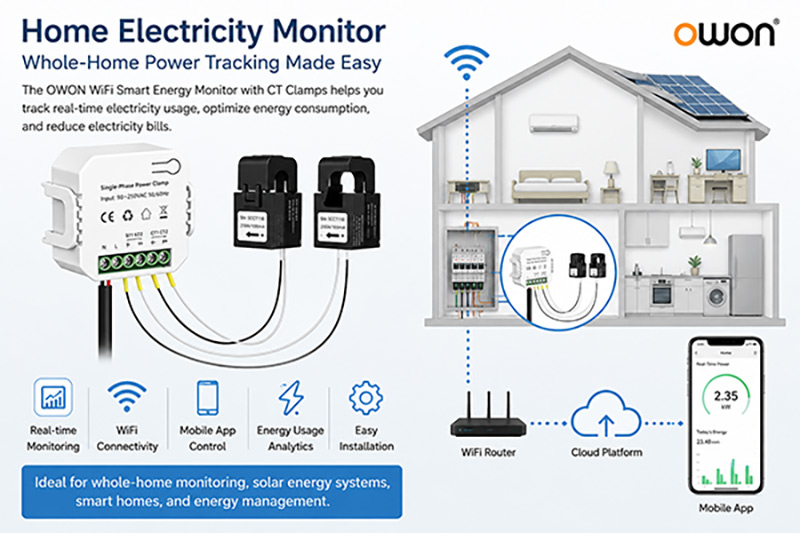
How Does a Home Electricity Monitor Work?
Most smart home electricity monitoring systems use CT clamp sensors or DIN rail energy meters to collect real-time electrical data.
Typical system architecture:
CT Clamp / Smart Meter → WiFi or Zigbee → Cloud Platform → Dashboard / Mobile ApThe system continuously measures:
- Voltage
- Current
- Active power
- Energy consumption
- Solar energy generation
- Grid import/export energy
The collected data can then be visualized through cloud dashboards or smart home platforms.For larger homes or properties with multiple key loads, whole home energy monitoring can provide deeper visibility into HVAC systems, lighting circuits, EV chargers, and solar energy usage from one centralized system.
CT Clamp vs DIN Rail Home Electricity Monitor
There are two common installation methods used in modern home electricity monitoring systems.
| Type | Advantages | Best For |
|---|---|---|
| CT Clamp Energy Monitor | Non-invasive installation | Existing homes and retrofits |
| DIN Rail Energy Meter | Compact panel installation | Smart electrical cabinets |
CT clamp-based systems are especially popular because they allow whole-home monitoring without cutting electrical wires.
DIN rail smart meters are commonly used in modern smart electrical panels and distribution boards.
WiFi vs Zigbee Home Electricity Monitoring
Wireless connectivity is an important part of modern smart energy monitoring systems.
| Technology | Advantages |
|---|---|
| WiFi | Direct cloud connection and remote monitoring |
| Zigbee | Low power consumption and mesh networking |
| MQTT | IoT platform integration |
| Modbus RS485 | Industrial EMS and BMS systems |
WiFi electricity monitors are ideal for direct mobile app access, while Zigbee-based systems are often preferred for larger smart home ecosystems using gateways.
Whole-Home Power Tracking for Modern Houses
A house electricity monitor can provide visibility into energy usage across an entire property.
Modern whole-home monitoring systems can track:
- HVAC systems
- Water heaters
- Lighting circuits
- Kitchen appliances
- EV charging systems
- Solar inverters
- Individual branch circuits
This allows homeowners to identify which devices consume the most electricity and optimize energy usage more effectively.
Smart Energy Monitoring for Solar Homes
As rooftop solar installations become more common, many homeowners now require bidirectional energy monitoring.
A bidirectional smart energy meter can monitor:
- Solar energy generation
- Imported grid electricity
- Exported surplus solar power
- Household energy consumption
This is especially important for homes using solar panels, battery storage systems, and EV chargers.
Example of Smart Home Energy Monitoring Solutions
For example, OWON provides several smart energy monitoring solutions designed for residential and commercial applications.
The OWON PC341 multi-circuit energy monitor supports whole-home power tracking with multiple CT clamps, allowing users to monitor HVAC systems, lighting, solar systems, and individual branch circuits in real time.
For smart electrical panels and distribution cabinets, WiFi DIN rail energy meters such as the OWON PC472 and PC473 support cloud-based monitoring, remote access, and smart energy management integration.
OWON also offers Zigbee and WiFi smart energy meters suitable for smart home ecosystems, IoT platforms, and energy management systems.
Benefits of Smart Home Electricity Monitoring
Installing a smart electricity monitor offers several important benefits.
Real-Time Energy Visibility
Users can instantly monitor household electricity consumption through dashboards and mobile applications.
Identify High Energy Consumption Devices
Homeowners can quickly identify inefficient appliances or abnormal energy usage patterns.
Reduce Electricity Costs
Understanding energy consumption behavior helps reduce unnecessary electricity usage.
Improve Solar Energy Utilization
Bidirectional monitoring helps optimize solar generation and household energy usage.
Enable Smart Home Automation
Modern smart electricity monitors can integrate with:
- Smart home systems
- HVAC controls
- Energy management platforms
- IoT dashboards
- Home Assistant platforms
Choosing the Best Home Electricity Monitor
When selecting a smart home electricity monitor, homeowners should consider:
- Single-phase or three-phase compatibility
- WiFi or Zigbee connectivity
- Solar monitoring support
- Whole-home or circuit-level monitoring
- Mobile app availability
- Cloud platform integration
- Ease of installation
For retrofit projects, CT clamp energy monitors are often the preferred choice because of their easy installation and scalable monitoring capability.
FAQ
What is the best home electricity monitor for whole-home tracking?
Multi-circuit CT clamp energy monitors are commonly used for whole-home energy monitoring because they can track multiple circuits simultaneously.
Can a home electricity monitor work with solar panels?
Yes. Bidirectional smart energy meters can monitor both imported grid electricity and exported solar energy.
What is the difference between WiFi and Zigbee electricity monitors?
WiFi meters connect directly to cloud platforms, while Zigbee systems typically communicate through gateways using mesh networking.
Are CT clamp energy monitors easy to install?
Yes. CT clamp systems allow non-invasive installation without cutting existing electrical wiring.
Can smart electricity monitors help reduce electricity bills?
Yes. Real-time monitoring helps homeowners identify inefficient devices and optimize energy usage.
Conclusion
A home electricity monitor provides real-time visibility into household energy consumption and enables smarter energy management for modern homes.
Whether using a WiFi DIN rail energy meter, a Zigbee smart electricity monitor, or a multi-circuit CT clamp monitoring system, smart energy monitoring solutions help homeowners improve efficiency, optimize solar energy usage, and better understand electricity consumption patterns.
As smart homes and IoT energy systems continue to grow, whole-home electricity monitoring is becoming an essential part of modern residential energy management.