If you’re a system integrator or developer designing for the commercial IoT space, you’ve likely added a Zigbee smart plug to your bill of materials. It’s a common component for controlling devices and monitoring energy in smart buildings, hotels, or retail spaces. But if you’re still thinking of it as just a basic on/off switch with a connectivity feature, you’re missing out on a critical piece of your system’s architecture.
The industry is undergoing a silent but significant shift in this exact thinking. The latest evolution of the standard, Zigbee 4.0, brings forward features like enhanced security, improved battery life, and crucially, bulk configuration for large-scale deployments. This underscores a key trend: Zigbee is maturing to meet the demands of commercial-grade installations, where managing hundreds of devices efficiently is paramount.
So, what separates a commercial-grade Zigbee smart plug from a consumer one? The answer lies in its dual role as both an endpoint and a network pillar.
-
Beyond Remote Control: The Critical Role of the Mesh Repeater
Every plugged-in Zigbee smart plug is a potential router for your wireless mesh network. While a simple plug might offer remote control, a robust commercial plug actively strengthens the entire system. It extends coverage and ensures reliable communication between other low-powered devices like sensors, door contacts, and thermostats, especially in environments with challenging layouts or thick walls. Specifying a plug that doesn’t perform well as a repeater can lead to network blind spots and system instability. -
Data-Driven Decisions: The Value of Accurate Energy Monitoring
For commercial and industrial applications, energy management isn’t a nice-to-have; it’s a core business requirement. A high-quality Zigbee smart plug provides more than just binary on/off data. It offers precise, real-time, and historical energy consumption data (kWh, voltage, current). This granular insight is indispensable for identifying energy waste, validating efficiency projects, submetering specific areas, and even predictive maintenance by spotting abnormal consumption patterns in equipment. -
Future-Proofing with Interoperability and Open Standards
The IoT landscape is fragmented, but the push for open standards is stronger than ever. A modern, well-designed Zigbee 3.0 smart plug offers native interoperability within the Zigbee ecosystem and is a foundational step toward broader compatibility through bridges to protocols like Matter. Choosing devices locked into proprietary ecosystems creates long-term vendor risk and limits system flexibility.
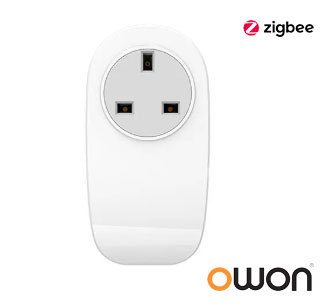
A Case for Purpose-Built Hardware: The Manufacturer’s Perspective
At OWON, as an experienced IoT device manufacturer and solution provider, we see this evolution firsthand. Our partners in system integration and OEM don’t just need components; they need reliable, intelligent nodes that form the resilient backbone of their projects.
Whether it’s for a smart hotel room managing guest comfort and energy use, an office building implementing granular sub-metering, or an industrial site requiring robust remote control, the “simple” smart plug is anything but. It’s a data source, a network guardian, and a building block for scalability.
We focus on delivering that reliability and intelligence through purpose-built hardware, ensuring our Zigbee devices, including smart plugs, are engineered to perform consistently in demanding, scaled environments. If you’re architecting a system where uptime, data integrity, and network health are critical, the choice of every component, down to the smart plug, demands a strategic second look.
For a deeper analysis of architectural choices in commercial IoT, such as the pivotal decision between centralized dongles and dedicated gateways, you can explore the extended discussion here: