As electrical systems become more connected and intelligent, traditional control components are being redefined. One such component is the WiFi DIN rail relay, which combines classic relay-based switching with wireless connectivity to enable remote control, automation, and smarter energy usage.
This article explains what a WiFi DIN rail relay is, how it works, where it is used, and why it has become an essential building block in modern power control systems.
Understanding DIN Rail Relays
A DIN rail relay is a modular electrical relay designed to be mounted on a standard DIN rail inside electrical cabinets or distribution panels. DIN rail mounting has long been the preferred format for industrial and commercial installations because it offers:
-
Clean and standardized panel layouts
-
Easy installation and replacement
-
Compatibility with breakers, meters, and controllers
Traditionally, DIN rail relays were controlled by physical switches, PLC outputs, or hardwired signals. While reliable, these systems lacked flexibility, remote access, and integration with modern software platforms.
What Makes a WiFi DIN Rail Relay Different?
A WiFi DIN rail relay adds wireless connectivity to the traditional relay form factor. This enables the relay to be controlled, monitored, and automated through IP-based networks rather than only local wiring.
Key functional differences include:
-
Remote on/off control via cloud platforms or local networks
-
Rule-based automation linked to time schedules, sensor inputs, or energy data
-
Integration with energy management systems, dashboards, or mobile apps
-
Reduced wiring complexity compared to traditional control loops
Instead of being a passive switching component, the relay becomes an active node in a smart power system.
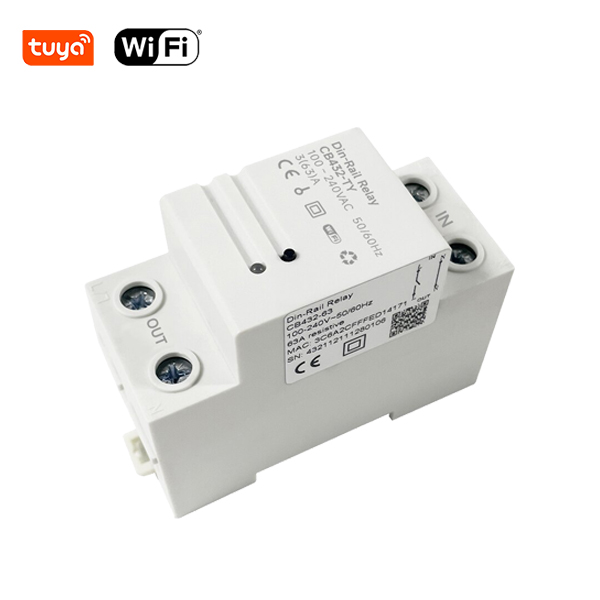
Typical Applications of WiFi DIN Rail Relays
WiFi DIN rail relays are widely used in scenarios where remote control, automation, and scalability are required:
Commercial Buildings
Used for lighting zones, HVAC equipment, signage, and non-critical loads, enabling centralized or remote control without rewiring.
Smart Electrical Panels
Installed alongside breakers and meters to provide intelligent load switching based on usage patterns or external commands.
Energy-Aware Load Management
Relays can be triggered based on power thresholds, peak demand limits, or energy schedules to reduce operating costs.
Industrial and Utility Cabinets
Deployed as control modules in distributed panels where Ethernet wiring is impractical but WiFi coverage is available.
Key Technical Considerations When Selecting a WiFi DIN Rail Relay
When evaluating a WiFi DIN rail relay, professional buyers typically focus on the following aspects:
-
Rated current and voltage (e.g., 240V AC, high-current loads)
-
DIN rail compatibility and enclosure size
-
Switching reliability for frequent operations
-
Network stability and recovery behavior after power loss
-
Compatibility with monitoring or automation platforms
In many real-world projects, relays are also paired with energy meters to create closed-loop control systems—where loads are switched based on real-time power data rather than fixed schedules alone.
The Role of Energy Monitoring in Relay-Based Control
An important trend in modern installations is the combination of WiFi DIN rail relays with energy monitoring. This allows systems to:
-
Disconnect loads when consumption exceeds thresholds
-
Prioritize essential circuits during peak demand
-
Enable data-driven automation instead of manual control
In such architectures, the relay acts as the execution layer, while the energy meter provides the decision-making data. This approach is increasingly common in smart buildings, distributed energy systems, and power optimization projects.
Industry Perspective: From Components to Solutions
From an industry standpoint, WiFi DIN rail relays are no longer treated as standalone components. They are becoming part of complete power control solutions that integrate switching, monitoring, connectivity, and cloud management.
Manufacturers with experience in both hardware design and IoT integration like OWON Technology are able to offer relays that work seamlessly within broader energy and automation ecosystems. For example, some commercially available WiFi DIN rail relays with energy monitoring are designed to fit directly into smart panels where control and measurement must coexist without increasing cabinet complexity.
These solution-oriented designs are increasingly favored by system integrators, panel builders, and energy solution providers.
Final Thoughts
WiFi DIN rail relays represent a natural evolution of traditional power control devices. By combining standardized mounting, reliable switching, and wireless connectivity, they enable smarter, more flexible electrical systems without disrupting existing panel designs.
As demand grows for remote control, automation, and energy-aware operation, WiFi DIN rail relays will continue to play a key role in modern power infrastructure—especially when paired with intelligent monitoring and scalable control platforms.