Remote control has become an essential requirement in modern HVAC projects. Across North America, system integrators, property managers, and HVAC solution providers are increasingly deploying wireless thermostat and receiver systems to simplify installation, improve control flexibility, and enable remote access to heating and cooling equipment.
Search queries such as thermostat with remote control, wireless thermostat and receiver, and remote thermostat control from phone reflect a growing need to understand how these systems work beyond consumer-level explanations. This article explores the core architecture behind wireless thermostat systems and explains how they support reliable remote HVAC control in real-world applications.
What Does “Remote Control” Mean in Thermostat Systems?
In professional HVAC environments, “remote control” does not refer to a handheld remote in the traditional sense. Instead, it describes the ability to:
-
Adjust temperature settings from outside the building
-
Monitor system status remotely
-
Control HVAC equipment without direct physical access
This remote capability is achieved through wireless communication between thermostats, receivers, sensors, and cloud platforms, depending on system design.
Understanding Wireless Thermostat and Receiver Architectures
A wireless thermostat system typically separates the user interface from the equipment control point. This separation is what enables flexible installation and remote access.
The most common architectures include:
-
Thermostat with wireless receiver
The thermostat communicates wirelessly with a receiver installed near the HVAC equipment. This approach is often used in central heating and boiler systems. -
WiFi-based thermostat systems
The thermostat connects directly to a network, allowing remote control via mobile apps or web dashboards. -
Thermostat with remote sensors
Wireless sensors provide temperature data from different rooms, improving comfort and control accuracy.
These architectures explain why users often search for wireless thermostat and receiver alongside wireless thermostat with remote sensor.
Remote Thermostat Control Without WiFi: Is It Practical?
One frequently asked question is whether remote control thermostats can work without WiFi.
Some systems rely on short-range RF communication between a thermostat and a receiver. While this allows wireless installation within a building, it typically limits control to local interaction. Off-site access, mobile control, and cloud-based monitoring usually require network connectivity.
For projects that demand true remote control—especially across multiple locations—WiFi or IP-based communication remains the preferred solution.
Why System-Level Design Matters for Remote HVAC Control
Wireless thermostat systems are not defined by a single feature. Their reliability depends on:
-
Stable power architecture (commonly 24VAC in HVAC systems)
-
Predictable control logic aligned with heating and cooling equipment
-
Consistent communication between thermostat, receiver, and platform
Without system-level design, remote control may become unreliable, especially in environments with long heating cycles or complex zoning requirements.
Industry Practice: Wireless Thermostat Platforms in HVAC Projects
In real HVAC deployments, wireless thermostat systems are selected based on application requirements rather than brand recognition alone.
For example, some manufacturers like Owon provide WiFi thermostat platforms that support both local control and remote access while maintaining compatibility with common HVAC infrastructures. Thermostat platforms such as PCT523 model are often used where stable power, reliable connectivity, and integration flexibility are required.
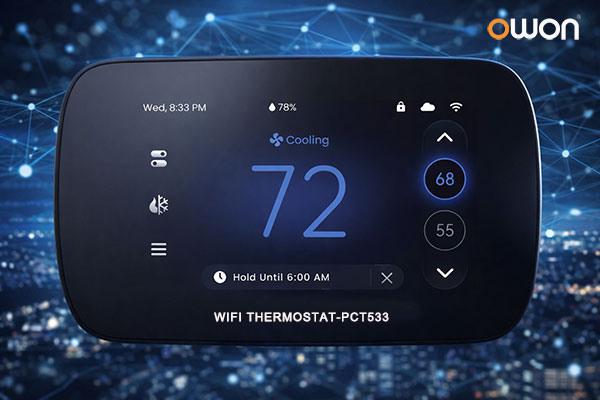
In projects that benefit from enhanced user interaction or integrated sensing, touchscreen-based platforms like PCT533 offer an expanded interface while functioning within the same system-level architecture. These examples illustrate how wireless thermostat and receiver systems are implemented as part of a broader HVAC control strategy rather than standalone devices.
Remote Control from Phone: What Makes It Reliable?
Mobile-based thermostat control depends on more than just an app. Reliable remote control requires:
-
Continuous device connectivity
-
Secure communication between thermostat and cloud platform
-
Hardware designed for always-on operation
When these conditions are met, remote thermostat control from a phone becomes a practical tool for property management, maintenance teams, and energy optimization.
Wireless Thermostats as IoT Devices
From an architectural perspective, modern wireless thermostats are IoT devices. They collect data, communicate over networks, and interact with other systems such as energy management platforms or building automation systems.
This IoT capability allows wireless thermostat systems to move beyond basic temperature control and support data-driven decision-making across HVAC operations.
Key Takeaways for HVAC Professionals
When evaluating wireless thermostat and receiver systems, HVAC professionals should focus on:
-
System architecture rather than individual features
-
Communication reliability over long operating cycles
-
Compatibility with existing HVAC infrastructure
-
Manufacturer experience in HVAC-grade product design
Choosing the right wireless thermostat system can significantly improve installation flexibility, operational visibility, and long-term reliability.
Final Thoughts
Wireless thermostat and receiver systems play a critical role in enabling modern remote HVAC control. By understanding how these systems are designed and deployed, professionals can avoid common pitfalls and deliver solutions that meet today’s expectations for flexibility and connectivity.
As HVAC systems continue to evolve, wireless thermostat platforms will remain foundational components in remote control and smart building strategies.
🔗 Further Reading
For a deeper system-level explanation of remote thermostat architectures and modern HVAC applications, see:
Wireless Remote Control Thermostat Systems for Modern HVAC Applications