When researching smart energy meter price, many buyers expect a simple number. In reality, pricing depends on technical specifications, communication features, compliance standards, and long-term system value.
Instead of asking “How much does it cost?”, a more useful question is: What determines the cost, and how does that cost compare over time?
Understanding these factors helps decision-makers evaluate value rather than focusing only on upfront expense.
What Influences Smart Energy Meter Price?
Several key elements shape the overall cost structure of a smart energy meter.
Measurement Capabilities
Basic meters may only measure total energy consumption, while advanced models support:
-
Three-phase measurement
-
Bidirectional energy tracking
-
Power quality monitoring
-
Multi-tariff billing
Higher precision and additional functionality generally require more advanced internal components.
Communication Technology
Connectivity plays a major role in pricing.
Smart energy meters may use:
-
Wi-Fi
-
Zigbee
-
Ethernet
-
Cellular (NB-IoT or LTE-M)
Meters designed for remote data transmission and IoT-based integration typically include additional communication modules, which affect hardware complexity and cost.
Certification and Compliance
For commercial or international deployment, regulatory standards are critical.
Certifications such as MID, CE, UL, or region-specific approvals require testing and validation. While these processes increase production cost, they ensure reliability, safety, and market access.
Integration and System-Level Value
Some smart meters function independently, while others are integrated into a broader home energy monitoring system or IoT platform.
When integration includes:
-
Cloud connectivity
-
API support
-
Data analytics
-
Remote firmware management
the value extends beyond hardware, influencing total lifecycle cost rather than just purchase price.
Upfront Cost vs. Long-Term Value
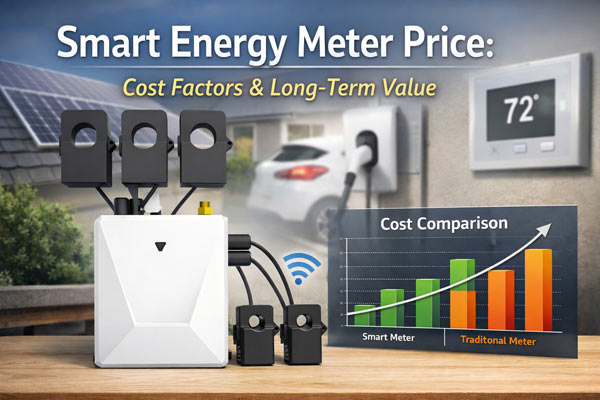
Evaluating smart energy meter price requires looking beyond the initial investment. Over time, data visibility and optimization can significantly influence operational efficiency.
5-Year Value Comparison
| Category | Traditional Meter | Smart Energy Meter |
|---|---|---|
| Initial Investment | Lower | Higher |
| Energy Visibility | Limited | Real-time monitoring |
| Optimization Capability | Minimal | Data-driven decisions |
| Maintenance Approach | Reactive | Predictive |
| Operational Efficiency | Moderate | Improved |
| 5-Year Total Cost Trend | Often Higher | Often Lower |
While smart energy meters may require higher upfront investment, improved efficiency and real-time monitoring often reduce long-term operational costs.
Residential vs. Commercial Pricing Context
Residential Use
In homes, buyers typically prioritize:
-
Basic energy visibility
-
Wi-Fi connectivity
-
App-based dashboards
Cost sensitivity is higher, and deployment scale is smaller.
Commercial and Industrial Use
For commercial projects, pricing reflects:
-
Scalability across multiple meters
-
Integration into centralized monitoring platforms
-
Regulatory compliance
-
Data management requirements
In these cases, total system performance and reliability usually outweigh small differences in unit price.
Why There Is No Single “Standard” Smart Energy Meter Price
Because configuration, communication protocol, certification level, and deployment scale vary widely, a single universal price does not accurately represent the market.
Instead, pricing should be evaluated within the context of:
-
Technical requirements
-
Integration goals
-
Operational scale
-
Long-term efficiency targets
When assessed from this perspective, smart energy meters are often viewed not simply as devices, but as components of broader energy optimization strategies.
Conclusion
The smart energy meter price is shaped by measurement precision, communication technology, compliance requirements, and integration capabilities. Rather than focusing solely on upfront cost, buyers benefit from evaluating total lifecycle value and long-term efficiency gains.
As energy management becomes increasingly data-driven, smart energy meters are positioned not just as hardware investments, but as foundational tools for sustainable and intelligent energy use.