As global demand for intelligent energy monitoring grows, many distributors, system integrators, and energy solution providers are turning their attention to smart energy meter manufacturers in China.
China has become a major hub for smart metering production, offering large-scale manufacturing capacity, flexible OEM/ODM services, and internationally compliant products. However, evaluating a manufacturer requires more than comparing price—it requires understanding technical capability, certification standards, and supply chain reliability.
This article explores what B2B buyers should consider when sourcing smart energy meters from China.
Manufacturing Capabilities and Product Range
Leading smart energy meter manufacturers in China typically provide a broad portfolio covering:
-
Single-phase power meters
-
Split-phase and three-phase systems
-
Multi-circuit monitoring solutions
-
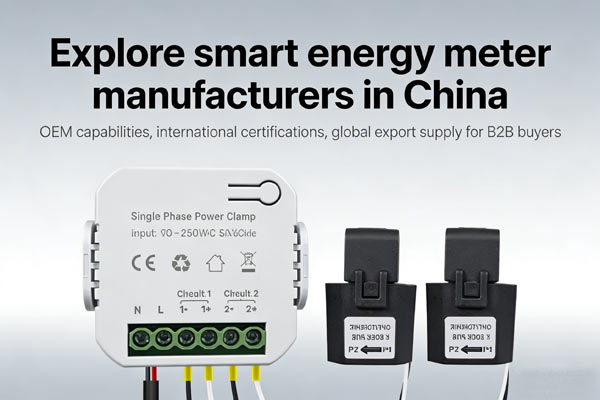
Clamp-type energy meters
-
Relay-integrated power meters
-
WiFi and Zigbee connectivity
Modern multi-circuit meters can support real-time voltage, current, power factor, and active power measurement, while DIN-rail WiFi meters enable mobile monitoring and relay control. Zigbee-based variants support secure wireless communication and OTA firmware upgrades.
A strong product portfolio demonstrates engineering maturity and the ability to serve multiple regional markets.
OEM and ODM Capabilities
For B2B buyers, OEM and ODM flexibility is often more important than standard catalog models.
OEM Capabilities Typically Include:
-
Private label branding
-
Custom packaging
-
Firmware localization
-
App and cloud integration alignment
-
Regional voltage adaptation
ODM Capabilities May Include:
-
Hardware modification
-
Customized current transformer configurations
-
Relay capacity adjustments
-
Communication protocol adaptation (WiFi / Zigbee / BLE)
Manufacturers with in-house R&D teams are generally better positioned to support long-term strategic partnerships.
International Certifications and Compliance
Compliance is critical when exporting smart energy meters to Europe, North America, or other regulated markets.
Common certifications include:
-
CE (European Conformity)
-
MID (Measurement Instruments Directive)
-
UL (United States)
-
FCC
-
RoHS
Smart energy meters designed for international markets typically support single-phase, split-phase, and three-phase electrical systems, ensuring compatibility across different grid standards.
Certification ensures not only legal market entry but also product reliability and long-term performance.
Global Supply and Export Markets
Chinese smart energy meter manufacturers commonly export to:
-
Europe
-
North America
-
Southeast Asia
-
Middle East
-
Australia
Key supply chain strengths often include:
-
Large-scale PCB assembly
-
Automated calibration systems
-
Injection molding production lines
-
Standardized quality control procedures
-
Stable production lead times
B2B buyers should evaluate:
-
Monthly production capacity
-
Quality assurance processes
-
Firmware maintenance and support
-
Long-term supply stability
Technical Standards and IoT Integration
Modern smart energy meters are no longer standalone devices—they are components of broader energy management ecosystems.
Technical expectations increasingly include:
-
Real-time data reporting
-
Bidirectional energy measurement
-
Remote firmware upgrades (OTA)
-
Cloud and smart home platform integration
Manufacturers capable of integrating with IoT platforms and energy analytics systems demonstrate stronger long-term competitiveness.
Key Evaluation Criteria for B2B Buyers
| Evaluation Area | What to Look For |
|---|---|
| Product Portfolio | Single & 3-phase, WiFi/Zigbee options |
| Certification | CE, MID, UL readiness |
| OEM/ODM Flexibility | Custom firmware & branding |
| Production Capacity | Stable monthly output |
| R&D Strength | OTA and IoT integration capability |
| Export Experience | Existing global distribution |
This structured evaluation framework helps reduce sourcing risk and improve long-term supplier relationships.
Conclusion
China has become a major production base for smart metering technology. However, selecting the right smart energy meter manufacturers in China requires a comprehensive evaluation of technical capability, compliance standards, OEM flexibility, and supply chain reliability.
For distributors and energy solution providers, long-term partnership value often matters more than unit cost. As global energy systems become increasingly connected, manufacturers that combine engineering expertise with scalable production are best positioned to support international markets.