The Growing Complexity of HVAC Control
As HVAC systems become more advanced, controlling them has also become more complex. Multi-stage heating and cooling, heat pumps, dual-fuel systems, and humidity management all add layers of logic that users are often not equipped to manage manually.
In light commercial buildings and multi-family housing, this complexity creates a challenge: how to deliver consistent comfort without requiring constant adjustment by occupants or facility staff. This has led to increasing interest in smart WiFi thermostats designed around simplified user interaction, including one-touch comfort and intelligent scheduling.
What Does “One-Touch Comfort” Mean in HVAC Control?
One-touch comfort refers to the ability for a thermostat to automatically bring a space to a comfortable condition with minimal user input. Rather than adjusting multiple parameters manually, users can rely on predefined comfort logic built into the thermostat.
In practice, this typically involves:
-
Pre-configured comfort temperature ranges
-
Automatic transitions between occupied and unoccupied states
-
Intelligent scheduling that adapts to daily routines
For commercial and multi-unit environments, this approach reduces operational friction while maintaining comfort standards.
Why Simplified Control Matters in Commercial Environments
In offices, clinics, hotels, and shared residential spaces, HVAC control must be intuitive. Occupants should not need to understand system complexity in order to achieve comfort.
Smart WiFi thermostats with simplified control logic help:
-
Reduce user errors and manual overrides
-
Maintain consistent comfort across multiple spaces
-
Support standardized HVAC operation policies
This is especially important in buildings where HVAC systems are managed by multiple stakeholders.
The Role of Intelligent Scheduling and Pre-Conditioning
Advanced WiFi thermostats often include features such as:
-
7-day programmable schedules
-
Pre-heating and pre-cooling based on expected usage
-
Temporary hold and override modes
These functions allow HVAC systems to prepare spaces in advance, reducing peak load and improving energy efficiency without sacrificing comfort.
A Practical Example of Simplified HVAC Control
Manufacturers focused on HVAC system integration are increasingly embedding one-touch comfort logic directly into thermostat platforms.
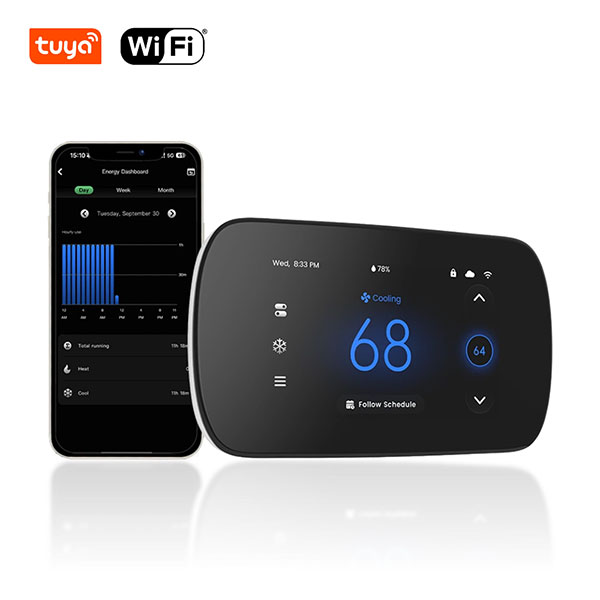
OWON Smart, for example, develops WiFi thermostat solutions that combine intuitive user interfaces with advanced control capabilities. The PCT533 WiFi thermostat integrates temperature, humidity awareness, and programmable scheduling into a single device, enabling HVAC systems to deliver consistent comfort with minimal manual intervention.
By simplifying interaction without reducing system capability, such designs support both occupant satisfaction and operational efficiency.
Deployment Considerations for Integrators
When evaluating smart WiFi thermostats for simplified HVAC control, integrators should consider:
-
Ease of configuration and commissioning
-
User interface clarity
-
Flexibility in scheduling logic
-
Compatibility with different HVAC system types
Simplified control is most effective when it aligns with real-world building usage.
Conclusion
As HVAC systems grow more capable, the importance of simplified control continues to increase. One-touch comfort and intelligent scheduling allow WiFi thermostats to bridge the gap between advanced HVAC functionality and everyday usability.
For light commercial and multi-family projects, smart WiFi thermostats designed with simplified interaction in mind offer a practical path toward better comfort and more efficient HVAC operation.
🔗 Learn more about Owon smart WiFi thermostat solutions