For the professional installer, system integrator, or smart home specialist, building a reliable and insightful energy monitoring system is a cornerstone of modern projects. Clients demand more than just data—they seek privacy, reliability, and deep integration. This is where the powerful combination of Zigbee power meters and the open-source Home Assistant platform rises above the rest, offering a future-proof, vendor-agnostic solution for true local energy intelligence.
The Professional Case for a Local, Zigbee-Based Architecture
Choosing the right infrastructure for energy monitoring is critical. While cloud-dependent Wi-Fi devices are common, they introduce latency, privacy concerns, and a single point of failure. For professional installations, a Zigbee-based system connected to a local hub like Home Assistant provides a superior foundation.
The key advantages for integrators are clear:
-
Complete Data Sovereignty: All data stays on the client’s local network. Sensitive energy consumption patterns are never routed through third-party servers, addressing critical privacy and compliance concerns for residential and commercial clients alike.
-
Unmatched Network Reliability: Zigbee creates a self-healing mesh network. Each plugged-in device strengthens the signal, making the system remarkably robust for larger properties and eliminating dead zones that plague Wi-Fi-based setups.
-
True Offline Operation: The entire system functions independently of the internet. Monitoring, automation, and control continue seamlessly during internet outages, ensuring constant operation.
-
Freedom from Vendor Lock-in: Home Assistant integrates hundreds of brands into one cohesive dashboard. This allows you, the integrator, to select best-in-class hardware for each job without being trapped in a single ecosystem, delivering the optimal solution for your client.
Core Components: Building a Professional Monitoring Stack
A robust energy monitoring system requires careful selection of each component, with the Zigbee power meter being the critical sensor at its heart.
1. The Zigbee Power Meter: Your System’s Foundation
Not all meters are created equal. For professional integration, the meter must be a reliable, accurate, and open data source. Key features to look for include:
-
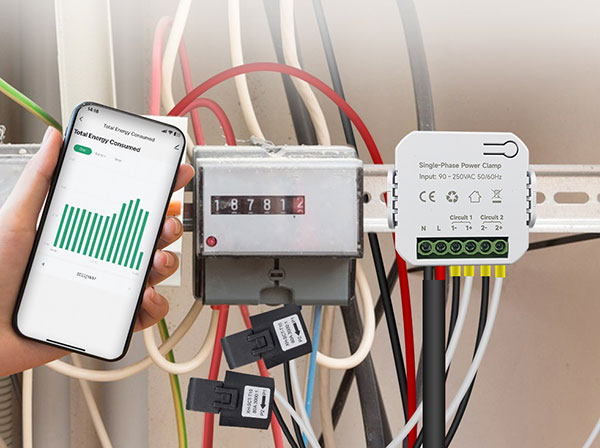
Clamp-On Current Transformers (CTs): Enables safe, non-intrusive installation on existing circuits without cutting wires—a must for retrofit projects and monitoring high-load panels.
-
Detailed Metrics: Beyond basic power (W) and energy (kWh), seek meters that provide voltage, current, and power factor for a complete electrical picture and diagnostic capabilities.
-
Stable Zigbee 3.0 Connectivity: Ensures reliable joining and communication within a diverse smart home network.
-
Native Local Integration: The device must work flawlessly with local gateways using standards like Zigbee2MQTT or ZHA, without requiring a proprietary cloud or bridge.
This is where purpose-built hardware shines. For instance, a meter like the OWON Zigbee Energy Meter PC-311 is engineered for this integration-first approach. Designed for discreet DIN-rail mounting and paired with external CT clamps, it acts as a pure, reliable data source for specific circuits, feeding precise information directly into your Home Assistant ecosystem without intermediary layers.
2. The Command Center: Home Assistant
Home Assistant is the indispensable brain of this operation. It transcends a simple dashboard by:
-
Correlating Data: It doesn’t just show energy use; it can link it with solar production data, weather feeds, and occupancy sensors.
-
Enabling Advanced Automation: Use real-time power draw as a trigger. Create automations to shed non-essential loads during peak tariff hours, alert on abnormal consumption, or generate custom efficiency reports.
-
Providing Professional Visualization: Build tailored, client-facing dashboards that highlight the key performance indicators (KPIs) that matter most for the project.
Implementation Guide: From Hardware to Insight
For the technician in the field, a clear, safe process is key.
Phase 1: Safe Hardware Installation
-
Safety First: Always de-energize the target circuit at the breaker before installation.
-
Install the CT Sensor: Clamp the sensor around a single conductor (e.g., the live wire to a specific appliance or circuit). Ensure the arrow marked on the CT points toward the load for correct measurement polarity.
-
Mount the Meter: Secure the Zigbee meter (such as the OWON PC-311) on a DIN rail within the electrical panel, connect its power supply, and attach the leads from the CT sensor.
Phase 2: Software Integration in Home Assistant
-
Set up the Zigbee Network: Using a compatible USB coordinator (e.g., Sonoff Zigbee 3.0 Dongle), add the “Zigbee2MQTT” or “ZHA” integration to Home Assistant.
-
Pair the Meter: Put the Zigbee power meter into pairing mode. Home Assistant will discover it and automatically create a suite of sensors
-
Configure the Energy Dashboard: Navigate to Home Assistant’s built-in Energy Dashboard. Here, you can assign the meter’s energy sensor to track the consumption of a specific appliance, circuit, or the whole home, enabling beautiful, long-term trend graphs and cost analysis.
Conclusion: Delivering Next-Generation Energy Intelligence
The transition to intelligent, data-driven energy management is no longer a luxury. For professionals, offering a system built on the open, local, and robust foundation of Zigbee and Home Assistant is a significant value proposition. It delivers what clients truly need: control, insight, and independence.
This approach empowers you to solve real problems—identifying phantom loads, verifying equipment efficiency, automating for savings, and providing tangible evidence of ROI. By leveraging reliable, integration-ready hardware designed for the task, you build systems that are not only smart but also trustworthy and enduring.
Looking for hardware designed for seamless professional integration? Explore the OWON PC-311 Zigbee Energy Meter and other robust IoT monitoring solutions. As an experienced IoT ODM, we provide the reliable, API-first components that form the foundation of sophisticated energy management systems.