Over the past decade, energy data has become one of the most valuable insights for households, small commercial buildings, and distributed energy systems. Traditional electricity meters can only provide historical readings, leaving users unaware of how their appliances behave, how much standby power is wasted, or whether solar systems are performing as expected.
Today, a new generation of smart power monitors is changing that picture entirely.
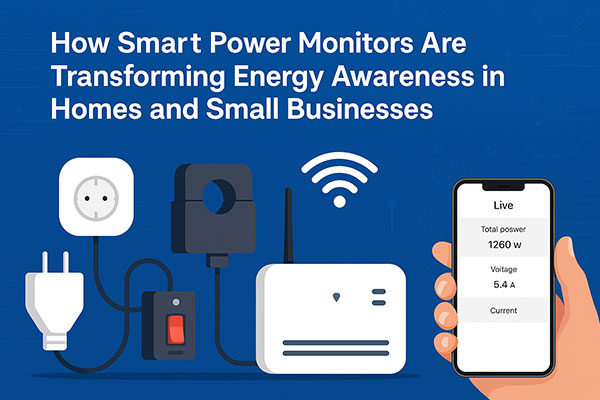
These connected devices—ranging from smart power monitor plugs, clamp-based sensors, panel-level breakers, and even IoT-enabled monitoring systems—are creating real-time visibility that was previously accessible only to large industrial facilities.
1. From Reactive Usage to Real-Time Intelligence
A smart power monitor device goes beyond simple measurement. It continuously tracks consumption, voltage, current, and power factor, then transmits this data to apps or cloud dashboards.
This shift enables:
-
Instant detection of unusual loads
-
Visibility of appliance-level energy consumption
-
Identification of standby waste
-
Alerts for abnormal or unsafe electrical patterns
Some installations use smart power monitor clamp sensors, which allow non-intrusive current measurement without rewiring. This makes them ideal for retrofits and small businesses.
2. Smart Monitoring Plugs: The Simplest Entry Point
For many users, a smart power monitor plug is the first step into energy intelligence.
Unlike a traditional smart plug, these models include built-in metering chips that show:
-
Exact wattage of connected appliances
-
Hourly and daily consumption
-
The impact of automation rules (scheduling, occupancy, demand response)
Because plugs are portable and affordable, they provide an easy way to understand where energy inefficiency begins.
3. IoT-Based Smart Power Monitoring Systems
More advanced users—including prosumers, solar owners, and small facility managers—often adopt a smart power monitor system using IoT.
These systems integrate multiple data sources:
-
Clamp sensors in breaker boxes
-
Smart thermostats and HVAC controls
-
Smart plugs and appliance-level meters
-
Solar inverters and battery storage systems
Through IoT protocols like Wi-Fi, Zigbee, LoRa, or MQTT, the system merges data into a single energy dashboard.
This turns fragmented information into actionable insight—helping users optimize loads, balance phases, and even automate when to use stored solar power.
4. Smart Breakers and Panel-Level Monitoring
A growing trend is the adoption of smart power monitor breakers.
These solutions allow:
-
Circuit-level energy visibility
-
Real-time overload warnings
-
Safety notifications
-
Integration with home automation platforms
Panel-level intelligence is becoming especially important in regions accelerating electric vehicle charging, heat pumps, and rooftop solar—where load balancing is essential.
5. Integration With Home Assistant and Open Platforms
One of the reasons smart monitoring is evolving so quickly is the rise of open ecosystems such as Home Assistant.
A smart power monitor Home Assistant integration gives users:
-
Local data processing
-
Automation triggers based on live power levels
-
Privacy control (no external cloud required)
-
Advanced dashboards through Grafana, InfluxDB, or custom add-ons
This appeals to both residential users and technical DIY audiences.
6. The Bigger Picture: Toward Intelligent Energy Ecosystems
Smart power monitoring is no longer a niche technology. It is becoming the foundation for:
-
Demand-response programs
-
Grid-interactive smart homes
-
Solar self-consumption optimization
-
Predictive maintenance of appliances
-
Safety monitoring for elderly or remote households
As hardware becomes more interoperable and IoT platforms mature, the industry is moving from simple measurement toward fully intelligent energy ecosystems.
⭐ Recommended Resource
If you want a deeper look at how modern monitoring technologies are reshaping the energy landscape, explore this guide:
👉 Smart Power Monitoring and the Evolution of Intelligent Energy Systems
7. Conclusion
The evolution of smart power monitoring—whether through plugs, clamps, breakers, or IoT energy platforms—marks a major shift in how homes and small businesses understand and manage electricity.
What once required industrial hardware can now be deployed quickly, affordably, and with far greater intelligence.
The result:
Lower energy bills, enhanced safety, and smarter electrical systems that adapt to user behavior.